
Newark City Directory Collections
The Charles F. Cummings New Jersey Information Center at Newark Public Library holds the strongest starting run for a Newark historical directory search. Its repository describes a fully digitized collection of city and crisscross directories from 1835 through 1964. The library scanned the volumes it owned in print and on microfilm under a 2016 Carnegie Grant. A year folder is a research route, not a promise that every name was captured perfectly. Check the title page, printed year, and image identifier before copying a result into family notes.
| Collection | Years | Where held | Access |
|---|---|---|---|
| Cummings Center city and crisscross directories | 1835-1964 | Newark Public Library repository and Cummings Center | Online scans, print, and microfilm |
| Holbrook Newark directory examples | 1878-1882 | New Jersey State Library material | Title and publisher comparison |
| Newark city and industrial directories | 1930-1939 selected years | New Jersey Historical Society | Finding-guide and library access |
| Circa-1930 Newark material | 1928-1931 | National Archives collection | Parallel coverage lead |
| Newark directory microfilm | 1861-1935 | New York Public Library catalog | Backup for a weak or missing scan |
These holdings overlap but do not create one uninterrupted publication history. Holbrook examples show a title change in 1882, while the Historical Society list names selected Newark years rather than a continuous run. That distinction matters. A gap can reflect a missing volume, a changed title, a cataloging difference, or an unreadable image. Record the repository and collection title with each result so another researcher can repeat the search.
Note: A title change or catalog gap needs checking before a missing directory year is treated as a lost record.
Newark City Directory Scan Limits
The NPL repository is large, with metadata listing 104 objects and 217,243 files. Its year folders make it possible to move from one printed volume to the next, but the scale also creates a practical limit: OCR may miss initials, broken type, tight columns, and street numbers. Search a surname and an address. Then inspect the page image. A result that looks close is still only a finding lead until the printed entry, year, and neighboring records agree.
The image below comes from the Newark Public Library city-directory collection, the digital route for the 1835-1964 run.
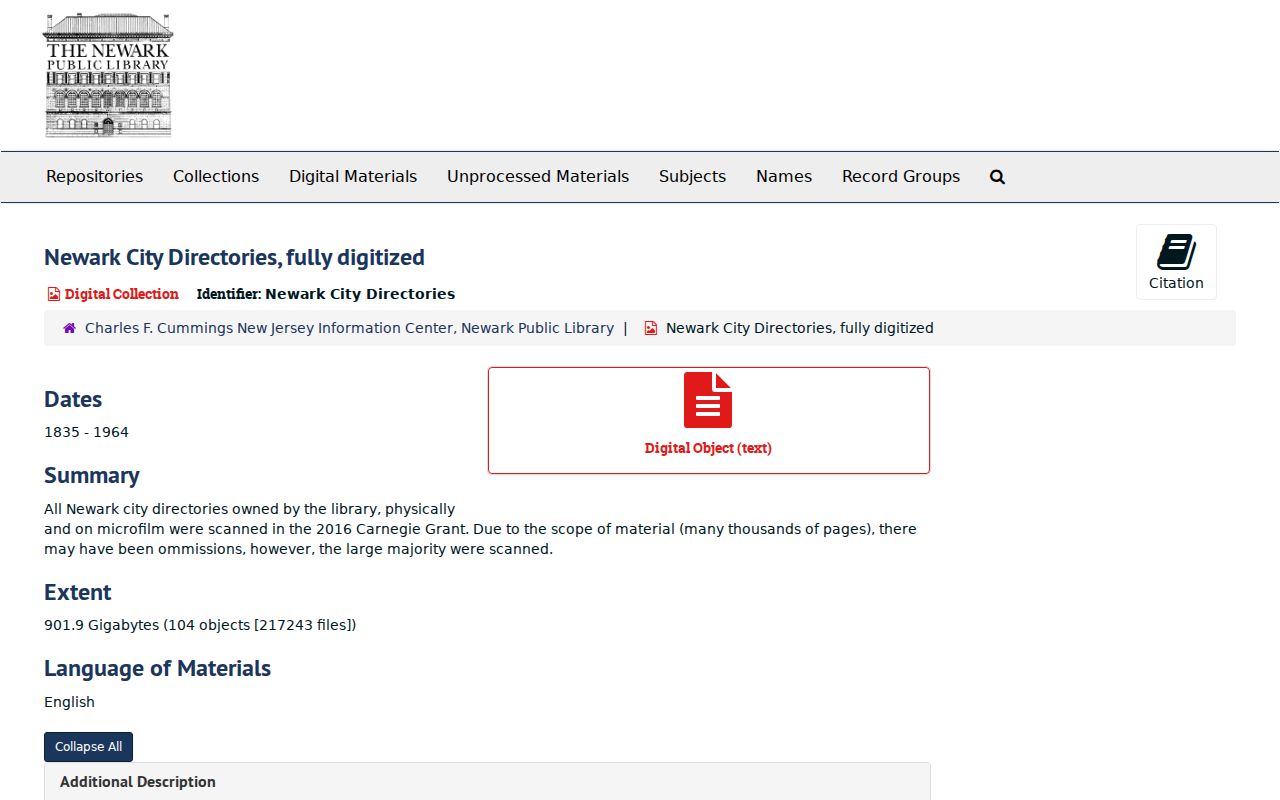
Use the repository display to preserve the volume year and image or page reference. When a name search fails, browse the lettered pages and try the address or a shorter spelling.
Adjacent years provide the best correction tool. A consistent street and initial can reveal a poor OCR read. A sudden change may instead signal a move, a changed household designation, or two people with similar names. Do not turn a removal or cross-reference notation into a cause of departure unless the printed volume says so.
Newark City Directory Research Desk
Digital access is not the only Newark directory-access channel. The Cummings Center is on the third floor of Newark Public Library, 5 Washington Street. Researchers can reach the center at 973-733-7775 or njreference@npl.org for help with Newark and Essex reference material, directory volumes, telephone books, and clippings. On-site staff can help distinguish a scan gap from a catalog gap and can point to the print or microfilm copy when the digital image is hard to read.
Newark Public Library
Charles F. Cummings New Jersey Information Center, third floor, 5 Washington Street. Phone: 973-733-7775. Email: njreference@npl.org.
New Jersey Historical Society
52 Park Place, Newark. Public library hours are Tuesday through Saturday, noon to 5 p.m. Phone: 973-596-8500 ext. 249.
The Historical Society adds family files, monumental-inscription and vital vertical files, deed and will card indexes, Newark scrapbooks, and photographs. Its genealogy and reference service is available at $50 an hour, or $25 for members, with a stated estimate of six to eight weeks; the service includes a limited number of copies or scans. That route can help when a directory name needs archival context rather than a fresh web search.
The image below leads to the New Jersey Historical Society finding guides, which organize the local manuscript and reference collections.
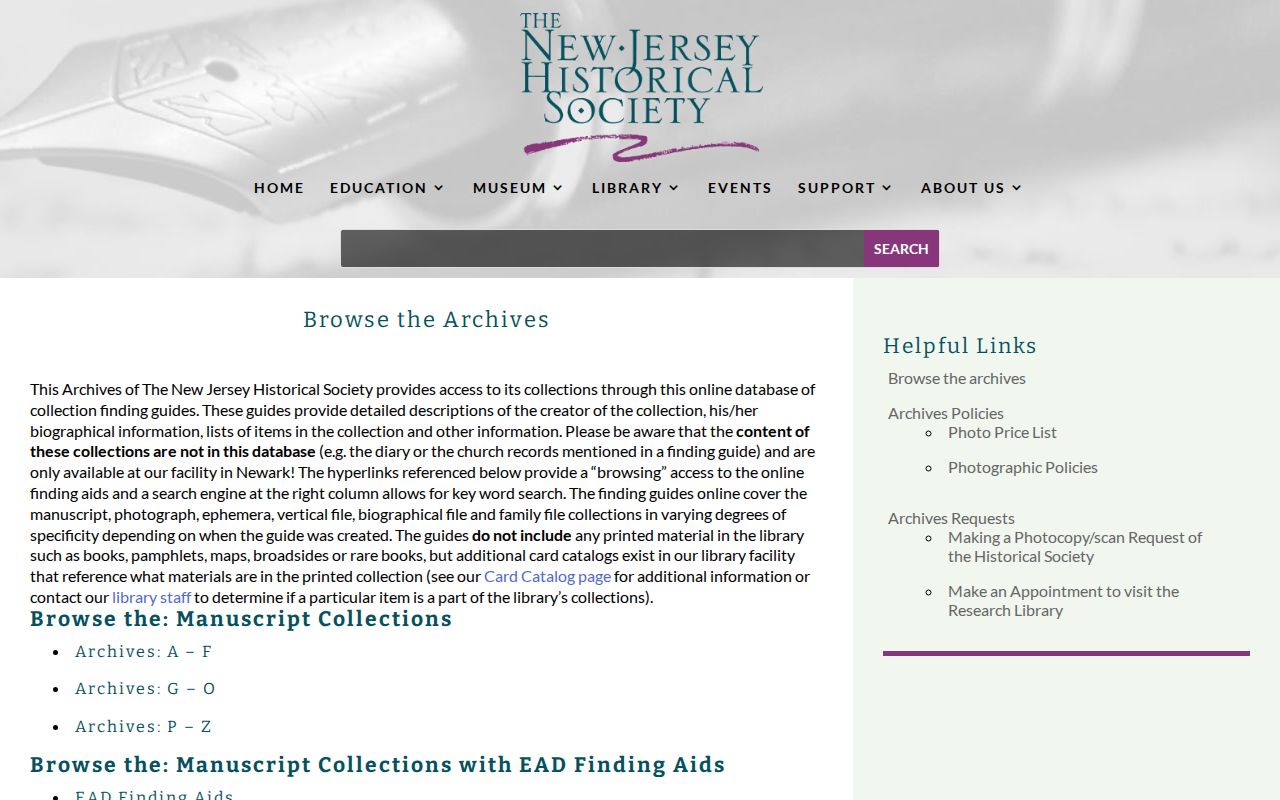
Use the guide before arranging an in-person visit or a paid request. A collection title, date range, and call reference make a much stronger request than a name alone.
Reading Newark City Directory Entries
A Newark directory entry is a period publication record, not a complete profile. Start with what was actually printed. The name line may include a surname, given name, initial, address, and an occupation or business line. Later books can add telephone information. Address crisscross material reverses the route: street number and street name lead to a printed person or business. Copy abbreviations exactly, then check the key in the front or back matter before expanding them in notes.
| Name line | Surname, given name or initial, as printed in that volume. |
|---|---|
| Address | Street number and abbreviated street name, useful only for that publication year. |
| Printed line | An occupation, business, or household designation when the directory includes one. |
| Crisscross entry | An address-to-name route for a person or business when the surname is unknown. |
| Reference | Volume title, year, page or image, and any printed cross-reference notation. |
- Crisscross directory
- The address-order portion of a directory, used to move from a street and number to a printed name or business.
- Householder index
- A name-oriented listing that may identify the listed household contact but does not establish every person at the address.
- Abbreviation key
- The volume's own explanation of shortened terms. Photograph or transcribe it before guessing at a mark.
A directory alone cannot prove present residence, legal ownership, complete household membership, or that two same-name entries are one person. Pair the entry with a dated census, newspaper page, tax account, recorded instrument, or archive record that answers the next specific question. Note: A legible scan still needs its printed year and page recorded for a reliable citation.
Newark Families in Archive Files
For family history, the directory shelves are a first stop rather than the final record. The Historical Society's collections include family genealogies, Bible records, cemetery and vital files, Genealogical Magazine of New Jersey material, biographical death and marriage notices, and Civil War burial references. Its Newark scrapbook collection has clippings from selected years between 1832 and 1995, while the Newark photograph collection spans the 1850s to the present, with much of it from 1890 to 1940. Those sources can supply a place, a date, or a spelling to test against a directory entry.
The New Jersey State Archives genealogy collections provide another route for historical births, marriages, deaths, wills, inventories, county surrogate material, chancery, naturalizations, and name-change judgments. For Essex naturalization records, the Archives form documents coverage from 1792 to 1931 and an up-to-five-year name search. The Archives research room offers access by appointment or walk-in space, with copying charged separately. Use the record type and approximate date that the directory supports, then request the underlying archival record through its named custodian.
Tracing Newark City Directory Households
Trace a household through the printed Newark volumes one year at a time. Begin near a known date, not with the first possible volume. A street change, a spouse notation, a business cross-reference, or an altered initial can give the next search term. Census schedules are especially useful as spaced checkpoints, while directories fill the years between them. Keep a separate line for each candidate name until the records show that the entries truly belong together.
- Select a directory year close to the known address, event, or census date and inspect its title page.
- Search the surname, initials, and address, then save the page or image number with the exact printed wording.
- Move backward and forward through adjacent years, recording address changes and any printed cross-reference notation.
- Use the crisscross portion for the same address to identify other printed names from that period.
- Compare the trail with a census, obituary or newspaper page, tax record, naturalization file, or recorded instrument.
Disappearance is not a conclusion. The person may have moved, died, used another spelling, appeared under an initial, or simply been omitted by that publisher. The NPL primary and secondary sources guide identifies Star-Ledger card-file coverage for 1972-1989 and Newark Evening News indexes for 1914-1972, with annual handwritten indexes beginning in 1914. Inspect the newspaper or microfilm page behind an index lead before citing it.
Newark Geography Behind Directory Addresses
Historic addresses need their own geography check. A Newark historical directory predates modern postal zones for much of its run, and a street can be better located by its ward, historic map, or block and lot than by a modern ZIP label. The Newark Public Library community-history guide recommends using maps, census, directories, newspapers, obituaries, postcards, and photographs together. That combination can show whether a street name, building footprint, or municipal label changed between two directory years.
The Library of Congress Newark Sanborn map for 1892, volume 4, contains 70 sheets and is useful for period building and utility context. An 1859 Newark atlas is another historical route noted by the Library of Congress collection introduction. Vailsburg Township's 1905 annexation is a reminder that the jurisdiction printed in an older source may not match a modern Newark label. For present-day parcel research, use the Newark Street Directory route after preserving the historical address as printed.
Note: Keep the printed jurisdiction beside the modern label when an older Newark address crosses an annexation or map-boundary change.
Newark City Directory Milestones
The timeline helps set the right expectation for a Newark directory search. It marks access and publication context, not a guarantee that every volume or name survives.
- 1835: The NPL digital city-directory collection begins its stated coverage.
- 1878-1882: State Library examples document Holbrook title and city-and-business directory changes.
- 1928-1931: National Archives material provides a parallel Newark directory lead.
- 1964: The NPL collection's stated directory span ends.
- 2016: Newark Public Library completed digitization of its owned print and microfilm directory run under a Carnegie Grant.
Use the publisher and year on the title page as the controlling citation, even when a repository folder has a shorter label. Historical directories are valuable because they preserve repeated, dated snapshots. Their strongest use is careful comparison across sources, places, and years.