
Newark Address Eras and Past Residents
Past occupants are best researched as a dated address trail. The record that works depends on the era. Essex PRESS supplies modern recorded instruments, while older deed work moves to office and archive sources. Newark’s digitized city directories can show a name or business printed at an address during a particular edition. Maps, photographs, and newspapers add context, but they do not replace the legal land record. Keep each source’s year, identifier, access route, and exact wording in separate notes.
| Source | Years it covers | Where held | What it can show |
|---|---|---|---|
| Essex deed-index series | 1688–1859 | New Jersey State Archives guide and historical series | Grantor/grantee index clues, volume and reel routes |
| Newark city and criss-cross directories | 1835–1964 | Newark Public Library digital collection and local-history desk | Printed names, addresses, business lines, and cross-references |
| Newark Sanborn map | 1892 example | Library of Congress digital collection | Mapped building, street, utility, and industrial context |
| Essex Register PRESS | 1996–present online | PRESS portal and Essex Register office | Recorded deeds and related instruments by parcel key |
| Newark photographs and scrapbooks | Collection dates vary | New Jersey Historical Society | Street, building, transportation, and local-history context |
Start with the source nearest the question’s date, then build outward. A search for who lived here before in a twentieth-century Newark house may begin with a directory year and map, while a recent transfer question starts with the current parcel and Register index. For early land, a surviving copy or abstract may be the strongest record available.
Newark Parcel Keys for Past Addresses
The backward trail begins with the city’s current property identifiers. Search Newark Online Tax by location and preserve the account, block, lot, qualifier, situs address, owner field, and tax-list year. Then use the State’s Municipality Lookup to confirm the standardized street address and jurisdiction. This step prevents a Newark mailing label or historic street form from being treated as a match to the wrong municipality.
A tax account is not a continuous ownership history. The tax list can lag a recently recorded transfer, and a mailing address may differ from the situs address. If a lot was split or combined, open a new branch in the research notes rather than forcing one unbroken parcel line. The NJGIN parcel resource can help with geometry and map context, though owner names may be redacted under Daniel’s Law.
Keep the layers separate. A tax owner, a deed party, a mailing address, and a directory entry each describe a different dated record field.
Essex Deed Chain for Newark Addresses
The Essex Register of Deeds and Mortgages holds the official land-record route for a Newark address. In PRESS, use municipality, block, and lot, then work through date windows no longer than 90 days. Capture the newest deed or transfer instrument and write down its recording date, instrument number, grantor, grantee, book and page, document type, and legal-description clues. A legal description identifies land in the instrument and is often more reliable than a street number when older records use a different address form.
- Pull the current account, block, lot, qualifier, and situs address from the Newark tax result.
- Search Essex Register PRESS by municipality, block, and lot within a 90-day period.
- Record the newest relevant deed or transfer, including the legal-description and prior-instrument clues.
- Use the earlier grantor, book/page, or legal-description reference to locate the preceding link.
- Repeat backward, comparing block, lot, and legal description at every link. Stop and mark the next custodian when the web coverage ends or the description becomes ambiguous.
- Grantor and grantee
- The grantor transfers an interest named in an instrument; the grantee receives the interest described there.
- Chain of title
- A sequence of recorded land instruments used to trace interests in a parcel over time.
- Legal description
- The property description in a land record. It can bridge historic records when a street number changes.
- Criss-cross directory
- A historical address-to-name directory section, distinct from a current occupancy record.
Note: A deed confirms recorded parties and a land instrument, not whether a party lived at the Newark address after recording.
PRESS Windows for Newark Previous Residents
PRESS states its online coverage begins October 1, 1996. That cutoff shapes a previous-residents search. Do not use a blank web result to conclude that an older address had no prior deed. Before the web window, move to the Register office, Public Vault, and the New Jersey State Archives Essex deed-record guide. The Archives guide identifies historical deed-index series for 1688 through 1859, with reel and series details to verify before a request or visit.
The Register’s in-person route is Hall of Records, Room 130, 465 MLK Jr Boulevard, Newark. Its contact page gives weekday hours of 8:30 to 4:30, with the final transaction at 4:15. Formal title work and office-held copies belong there. County guidance lists copies at $2 each and copies made or marked true at $4, with added charges for selected instruments, so confirm the current total with the office before ordering.
A notable Newark survival issue shows why old sources must be read carefully: New Jersey Historical Society material reports that an original 1703 Newark deed was lost in a fire, while a true copy survives in a 1714–1813 volume. A later copy, index, microfilm reel, or manuscript volume can therefore be the best surviving starting point for an early address trail.
Newark Maps as Household Evidence
Maps and images place an address in its physical setting, but they should never be used to identify a private household. The Library of Congress Newark Sanborn map, an 1892 volume of 70 sheets, can show mapped buildings, streets, utilities, and industrial context for that year. An 1859 Newark atlas noted by the Library of Congress helps when a directory street alignment does not match a modern parcel. Pair a map sheet with its publication year and the directory edition being examined.
The New Jersey Historical Society’s Newark photographs collection describes streets, commercial buildings, transportation, industry, and other visual context from the 1850s to the present, with much of the collection dating from 1890 to 1940.
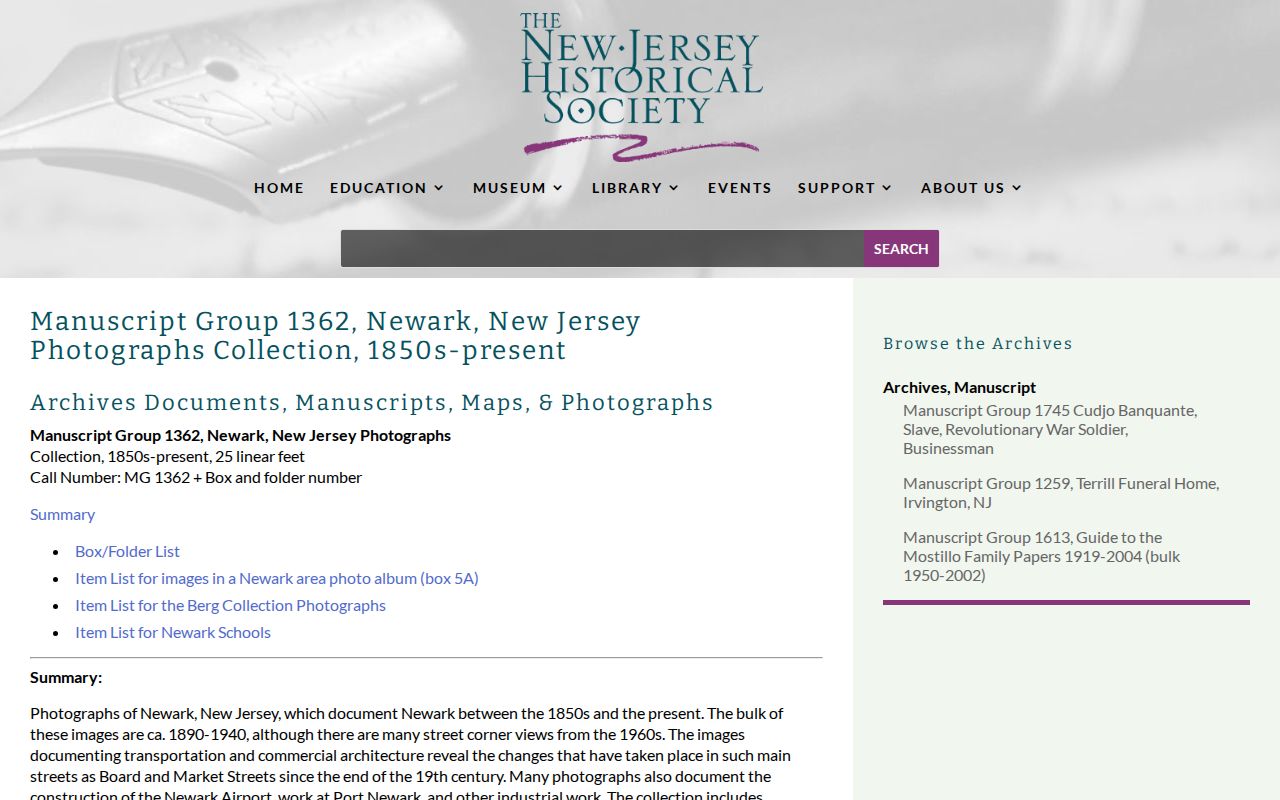
Its finding guide can help connect a Newark address to a street or building image, while the property and directory records remain the sources for dated names and land details.
Note: Cite a map or image by its edition, collection, and year because the visible building or street feature can change over time.
Newark Previous Residents in Directories
Past residents are often visible through a directory before they appear in a land-record chain. The Newark Public Library Charles F. Cummings New Jersey Information Center digitized its Newark city-directory collection for 1835 through 1964. The collection includes city and criss-cross directories, which can move from an address to a printed name or from a name to an address. Search the target street in several nearby years, record initials and business notation exactly as printed, and cite the year plus page or image.
Use a household flow that keeps the evidence dated: address and directory year, then a matching census year when access and geography allow, followed by a map or newspaper check. Search both the surname and address because OCR can miss names and street numbers. A removal or arrival notation is a period publication detail, not proof of why a person moved. The digitized collections, physical holdings, and staff context are covered on the Newark Directory Book.
- Select a directory edition near the desired Newark date and inspect its title page.
- Search the street address, the surname, and plausible spelling or suffix variants.
- Check an earlier and later edition for continuity, and retain every page or image identifier.
- Compare the entry with a census, map, tax record, or instrument only as a separate layer of evidence.
Newark Records That Close a Trail
A Newark address history can gain context from sources that do not name an occupant at every date. The NPL primary and secondary sources guide identifies a Cummings card-file index to the Star-Ledger for 1972 to 1989, Newark Evening News indexes for 1914 to 1972, and annual handwritten newspaper indexes beginning in 1914. These are finding aids. Inspect the underlying newspaper or microfilm record before relying on a name, address, fire, obituary, or other item.
For family-history evidence, the State Archives genealogy collections route historical vital, probate, chancery, naturalization, and name-change research through their finding aids. Its Essex naturalization request form covers 1792 to 1931 and lists a $5 search for up to five years, while post-1906 federal naturalization files route to NARA. The New Jersey Historical Society library services also offers genealogy and reference help, with source types, fees, and turnaround described by the repository. These channels can fill a gap, but they do not convert a historical mention into proof of identity.
Newark Previous Residents and Privacy
A complete list of everyone who lived at an address is not a public record product. A directory name, a tax owner, an instrument party, and a map label have separate limits. Current data may be protected even when an old directory is available. NJGIN warns that owner names can be redacted from hosted parcel data under Daniel’s Law, and New Jersey’s Address Confidentiality Program can provide a lawful substitute address in covered situations.
Lawful use. Use Newark address history for family research, house history, estate questions, and civic curiosity. Do not use old or current records to stalk, harass, or harm a person.
Record uncertainty plainly. A same surname at the same street, an unverified OCR result, or a matching mailing address is a lead, not an established identity. When the evidence becomes ambiguous, stop at the documented source and ask the responsible archive, library, Register, or agency for its appropriate access route.