
Trace a Newark Street by Address
Begin a Newark street directory question with a complete address rather than a surname. The State's Municipality Lookup standardizes the address and confirms its municipality. That check matters near a city edge. It also matters when an old mailing label clashes with the parcel. Next, the city tax account can tie the location to an account number, block, lot, qualifier, and owner field. It also carries a property-location string. Those identifiers outlast a street number. Lots change. Older sources spell streets differently.
Work forward from the address with a dated note beside every result. Keep a tax result separate from a recorded instrument. Do the same for a voter-list response and a historical directory entry. A deed names the parties to a transfer. A city-directory line is simply a period publication entry. That difference matters when you want to understand a building. It lets you research the place without making any claim about a living household.
- Confirm the complete address and municipality, then save the standardized street form.
- Search Newark Online Tax by location. Record the account, block, lot, qualifier, owner field, and tax-list year returned.
- Use the block and lot with the Essex Register PRESS index to locate dated instruments for the parcel.
- For an election-record need, use the Essex County Clerk’s voter-list request route. It is a records request, not a general household roster.
- Match a past address entry against the Newark Public Library’s city and criss-cross directories, then verify its year and image or page.
Note: Save the source date beside every address result, because tax lists, recorded instruments, and printed directories each update on their own schedule.
Newark Street Address Keys First
The city tax search bridges a Newark street address to land records. It is the best first stop for that match. A location search yields the account and parcel components the Register index needs. If the address will not resolve cleanly, try the exact street type and directional form. Drop a unit only when jurisdiction confirmation requires it. Keep an apartment or qualifier in your notes if a legitimate source shows it. But never assume a tax-card mailing address equals the situs address, the physical property location.
| Newark tax field | How it helps a street search |
|---|---|
| Account# | City account key for a returned property record. |
| Block and lot | Parcel identifiers used to narrow an Essex PRESS instrument search. |
| Qualifier | Optional unit-style parcel refinement when the city record provides one. |
| Owner | Tax-list field, useful for comparing records but not proof of current occupancy. |
| Location | Address search field that starts the Newark property-record trail. |
The State's property transparency resource adds tax-list and map context. It carries land, building, total-assessment, and property-class fields. Its annual January tax-list basis can lag a later recorded transfer, so use it as a dated comparison rather than a real-time ownership statement.
Newark Street Deeds in PRESS
Essex Register PRESS is the key official index. It covers instruments tied to a Newark street parcel. Its online notice states coverage from October 1, 1996. Choose the block-and-lot search, pick the municipality, and keep each date range within 90 days. The index also offers instrument number, document type, and name modes. For an address question, block and lot avoids false leads. A common name or a company sitting in the party field can mislead a name search.
From each result, collect the instrument number, document type, recording date, parties, book and page where shown, legal-description clues, and image availability. Then compare the newest deed with the current tax-list year. A recording date may differ from the event date printed inside the instrument. An annual tax-list owner can also trail the newest recording. The portal describes its data as informational, so formal title work belongs with the Register office.
The Essex County Register sits at Hall of Records, Room 130, 465 MLK Jr Boulevard, Newark. Weekday hours are 8:30 to 4:30, with a 4:15 last transaction. It is the in-person route for formal title work and office-held copies. For a pre-1996 Newark street trail, consult the Register, the Public Vault, and the New Jersey State Archives Essex deed guide rather than treating PRESS as continuous history.
The official PRESS search screen displays the block-and-lot, name, document-type, and instrument routes. These move a Newark street address into the recorded land trail.
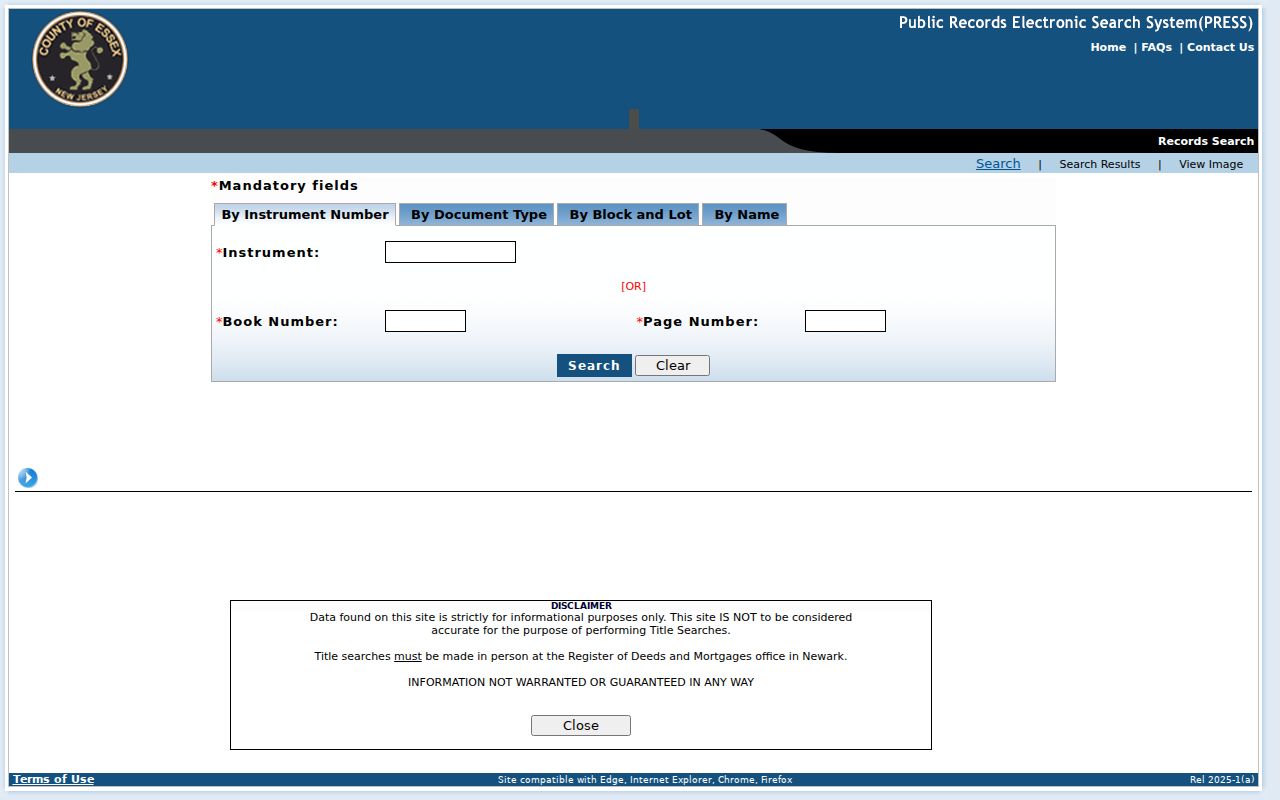
Those separate search modes show why the parcel key should lead a street directory search. A name-only result always needs corroboration.
Newark Street Geography and Boundaries
A street name is just one layer of Newark geography. The city’s official ward materials lay out wards, voting districts, blocks, and parcels. That gives a resident lookup its civic frame. Historic-landmark material adds named areas such as Forest Hill, North Broad Street, James Street Commons, Military Park Commons, Four Corners, Lincoln Park, and Weequahic Park. A label like these places a street in preservation or civic context. None of them defines a parcel’s legal boundary. A ward, a historic district, and a ZIP code each answer a different question about the same address.
The NJGIN parcel resource handles parcel geometry and map-service detail. Owner names are redacted from its hosted parcel and tax-list data under Daniel’s Law. A blank field thus reflects privacy protections rather than missing work. Resist rebuilding an address from some other source to fill the gap. Newark’s West Ward map and landmark material also help with date-specific geography. They matter especially where a street crosses a district line.
Jurisdiction shifts over time as well. The Newark Public Library chronology notes the 1905 annexation of Vailsburg Township into the city. An older directory or deed may therefore name a municipality that no longer stands alone. Keep the spelling and municipality exactly as printed, and add a modern Newark reference only as a cross-reference. Newark publishes no citywide street-renumbering schedule. So never claim a number changed without a dated map or primary record in hand.
Note: Keep Newark ward, historic-district, ZIP, and parcel labels separate, since each answers a different geographic question about one address.
Newark Street ZIP and Ward Checks
One Newark address can carry several geographic labels. Each label needs its own check. ZIP codes serve postal delivery, while wards and voting districts belong to civic geography. Newark ZIP-description material pairs 07105 with the Ironbound and 07106 with Vailsburg. Neither pairing settles a neighborhood’s legal edge or a parcel’s boundary. When a street’s city jurisdiction is unclear, start with the New Jersey Municipality Lookup before anything else.
Treat ZIP information as a way to narrow a resident lookup. It should not settle an address question. Newark’s 07101 is commonly described as a PO Box ZIP. Its 07182 is often called a unique or shared-firm ZIP. Neither works as an ordinary street-resident area. Historic city directories and maps predate ZIP codes altogether. So resist pasting a modern postal label onto an old record. For those sources, keep the printed street, ward, municipality, and map year just as published.
Newark Street Permit and Inspection Routes
Some address-led records describe a building rather than the people in it. Newark's Health Inspection Lookup takes an address or establishment name. It then opens the report for a public match. The city inspects routine retail food establishments at least annually. An inspection report, though, is a dated account of an establishment. It is not a household record for a residents directory. Read it that way and nothing more.
The Newark Building Division runs construction permits and inspection services. It does so through its Uniform Construction Code process. Its published guidance lays out certificate-of-occupancy, construction-permit, and UCC form routes. Certain submissions are accepted by mail or in person at 920 MLK Boulevard, Room B-23. Confirm the live city route before sending any request. Where no direct portal fits, file a narrow written OPRA request. Name the property record and its date range.
Newark Street Records by Address
Several public sources can be searched by street or shaped into an address-led workflow. Each answers a different question. The city tax index identifies a property record. The parcel layer maps it. PRESS identifies recorded instruments. Historical directories show a printed name or business at an address in a given year. Match the keeper and access route to the record you actually want, rather than requesting a broad list of people on a street.
| Address record | Newark or Essex keeper | Street clue | Access route |
|---|---|---|---|
| Tax account | City of Newark | Location, account, block, lot, qualifier, owner field | Newark Online Tax search |
| Parcel geometry | NJGIN | Parcel shape and map layer | State parcel resource, owner data may be redacted |
| Recorded instruments | Essex Register | Deed parties, dates, book/page, legal-description clues | PRESS online, Register office for formal and older work |
| Voter list | Essex County Clerk | Election-record request by district | County request path and fee schedule |
| City and criss-cross directories | Newark Public Library | Historical address-to-name or name-to-address entry | Digitized collection, library help, and microfilm holdings |
| Permits and inspections | Newark UCC and Health | Property work or public establishment report | City office, mail or in-person route, and official lookup where offered |
Newark’s Health Inspection Lookup searches by address or establishment name. It opens a public inspection report for a match. The Building Division’s UCC service page identifies construction-permit and inspection paths. Its guidance allows certain submissions in person or by mail to 920 MLK Boulevard, Room B-23. Check the city page for live portal and payment links. Do this before relying on any form route.
Historic Newark Street Clues
A modern street directory result cannot replace the historical shelf. The Charles F. Cummings New Jersey Information Center at the Newark Public Library holds digitized Newark city and criss-cross directories. The run covers 1835 through 1964. Search a street number and name in the address section. Record the printed name or business line. Then check adjacent years. Initials, abbreviations, OCR gaps, street suffixes, and older spellings all demand care. The collections are available through the Newark Directory Book.
For the built environment, the Library of Congress Newark Sanborn volume of 1892 offers 70 sheets. These cover building, street, utility, and industrial context. It is a map for that year, not a current parcel viewer. Pair it with the matching city directory year and a property identifier. The NPL community-history guidance also points to other layers of evidence. These include maps, census records, newspapers, obituaries, postcards, and photographs.
- Parcel
- A defined piece of land in a tax or map system, often identified in Newark by block and lot.
- Situs address
- The physical property location. It may not match a mailing address shown on a tax record.
- Plat or map sheet
- A mapped depiction used to locate land or buildings for a particular publication date.
- Criss-cross directory
- A historical address-to-name section that can be searched when the surname is not known.
Note: A historic directory entry proves only what its publisher printed for that edition, so cite it with its year and page or image.
Newark Street Record Dates Matter
Dates do the heavy lifting in any street search. Each Newark record source covers its own slice of time. The tax list is a yearly snapshot. PRESS opens its online run in 1996. The State Archives guide maps Essex deed-index series from 1688 through 1859. The Newark directory collection starts in 1835. The cited Sanborn volume captures 1892. Treat these as windows of evidence. None of them promises that every year in between is online or filled in.
Watching for future land records is easier than it sounds. The Register offers a free Essex Record Alert service. It tracks a name or a block and lot for later recordings. It watches ahead only; it is not a historical search. When a city or county record sits outside any portal, send a narrow written request to the custodian who holds it. New Jersey's OPRA process runs smoothest when the request names the record. It also helps to give a date range. State the preferred inspection or copy format.
Newark Street Privacy Limits
No Newark street directory can list every person inside a building. Each record answers a different question. Tax rolls show ownership. Directory entries show listed names. Voter records or deed parties follow their own timelines and purposes. New Jersey's Driver Privacy Protection Act keeps DMV files out of ordinary address searching. Parcel and map layers may also withhold details under Daniel's Law. The Address Confidentiality Program lets covered residents use a lawful substitute address.
Lawful use. Newark street and address records are for careful personal, family-history, property-history, or civic research. Never use a record to stalk, harass, intimidate, or harm a person.
Sometimes the search narrows from a whole street to one documented person. In that case, compare exact identifiers with the right official custodian instead of trusting a shared surname or a nearby map dot. A tax owner, directory listing, or map neighbor is only a lead. Treat it as something that still needs independent confirmation.